
Most flights go unnoticed. You board, buckle in, and before long you’re back on the ground. But sometimes, something happens that changes everything — midair.
That’s what turned a routine trip into a tense reroute for the passengers of Delta Flight DL275. What started as a standard transpacific flight quickly became a trending topic, all because the plane didn’t land where it was supposed to. The sudden diversion sparked questions, speculation, and a whole lot of attention online.
So, what really happened? Why was Delta Flight DL275 diverted LAX without warning? Here’s a closer look at how things unfolded and what it says about flying in today’s world.
Everything Was Normal — At First
The journey began like any other long-haul flight. Delta Flight DL275 lifted off from Incheon International Airport in South Korea, bound for Atlanta. It’s a route Delta operates regularly — thousands of miles over the Pacific, through American airspace, and straight into Georgia. No drama. Just hours of cruising at altitude.
There were more than 200 people onboard. Most had settled in for the long trip, scrolling through in-flight entertainment or catching some rest. The crew moved efficiently through the aisles. Meal service rolled out. Cabin lights dimmed. It was the usual routine, and everything felt stable.
Then, the plane shifted course.
A Midair Turn That Sparked Suspicion
At first, no one made much of it. Planes adjust paths all the time to avoid turbulence or to pick up favorable winds. But this wasn’t a slight veer. The aircraft turned west — away from Atlanta and toward California.
Some passengers started paying closer attention to the flight maps on their screens. Others noticed the faint curve in the plane’s direction and began to whisper. It wasn’t just a momentary drift. The aircraft was clearly heading away from its intended destination.
Without any clear announcements, the tension in the cabin began to build. People started to wonder what was going on. When the crew asked everyone to return to their seats and fasten seat belts, even those trying to ignore the shift knew something was off.
Then came the captain’s voice over the speaker. Calm but vague. He mentioned a technical matter. Nothing serious, just a precaution. Still, the message left plenty of room for questions.
And just like that, Delta Flight DL275 diverted LAX — quietly, smoothly, but with uncertainty hanging in the air.
Onboard Reactions: Quiet, Tense, and Guesswork
Inside the cabin, confusion took over. The crew kept things professional, moving with calm urgency but offering no real details. That’s common in situations like this — the crew knows only what’s been confirmed, and they don’t want to stir panic.
Some passengers stayed quiet, staring at their screens. A few whispered theories to each other: “Maybe someone’s sick?” “Did something break?” “Could it be the weather?”
But skies were clear. There were no storms nearby. The plane hadn’t dropped altitude rapidly. No alarms. No strange noises. No chaos.
All passengers could do was sit, wait, and watch the route change. With no further announcements, they could only assume the crew was following standard safety protocols.
That’s the tricky thing about air travel. When something goes wrong — or even just feels wrong — passengers rarely know what’s happening. And in this case, the answer wasn’t coming right away.
The Statement from Delta
Once the plane landed safely at Los Angeles International Airport, Delta moved quickly to confirm the diversion. Their public statement was brief and measured. It said the flight had been rerouted due to a mechanical issue that required a “precautionary landing.”
It didn’t go into specifics.
This type of response isn’t unusual. Airlines often use general phrasing when the exact cause is still under review, or when the issue didn’t pose an immediate threat. The term “mechanical issue” covers a broad range of possibilities — and in aviation, even the smallest anomaly gets treated seriously.
The key word in Delta’s statement was “precautionary.” That told experienced flyers what they needed to hear: nothing catastrophic happened. Still, it didn’t explain why Delta Flight DL275 diverted LAX instead of continuing on to its final destination.
What Might Have Gone Wrong?
Aviation experts and enthusiasts didn’t wait for the official answer. Within hours, forums were buzzing. Flight data was analyzed. Air traffic radio recordings were reviewed. And the flight’s sudden turn sparked dozens of theories.
The aircraft, a Boeing 777, is known for its reliability. But even the best planes throw warnings from time to time. And pilots are trained to take those alerts seriously.
There was no sign of rapid descent or erratic flight behavior. The descent into LAX was gradual, controlled, and clean. That ruled out cabin pressure issues, fires, or fuel leaks — the kind of things that force urgent landings.
So, what could’ve prompted the change in course?
These were the most likely causes floated by professionals:
- A warning related to fuel sensors or fuel distribution systems
- Slight fluctuations in cabin pressure that required further inspection
- Faults in electrical backups or power routing systems
- Automated flight control inconsistencies, like autopilot misreads
None of these necessarily threaten a flight immediately. But when one shows up midair, pilots have a choice: keep going for several more hours, or land near top-tier maintenance support. With Los Angeles right in range, the answer was clear.
That’s probably why Delta Flight DL275 diverted LAX — not out of panic, but out of smart planning.
Social Media Took Off
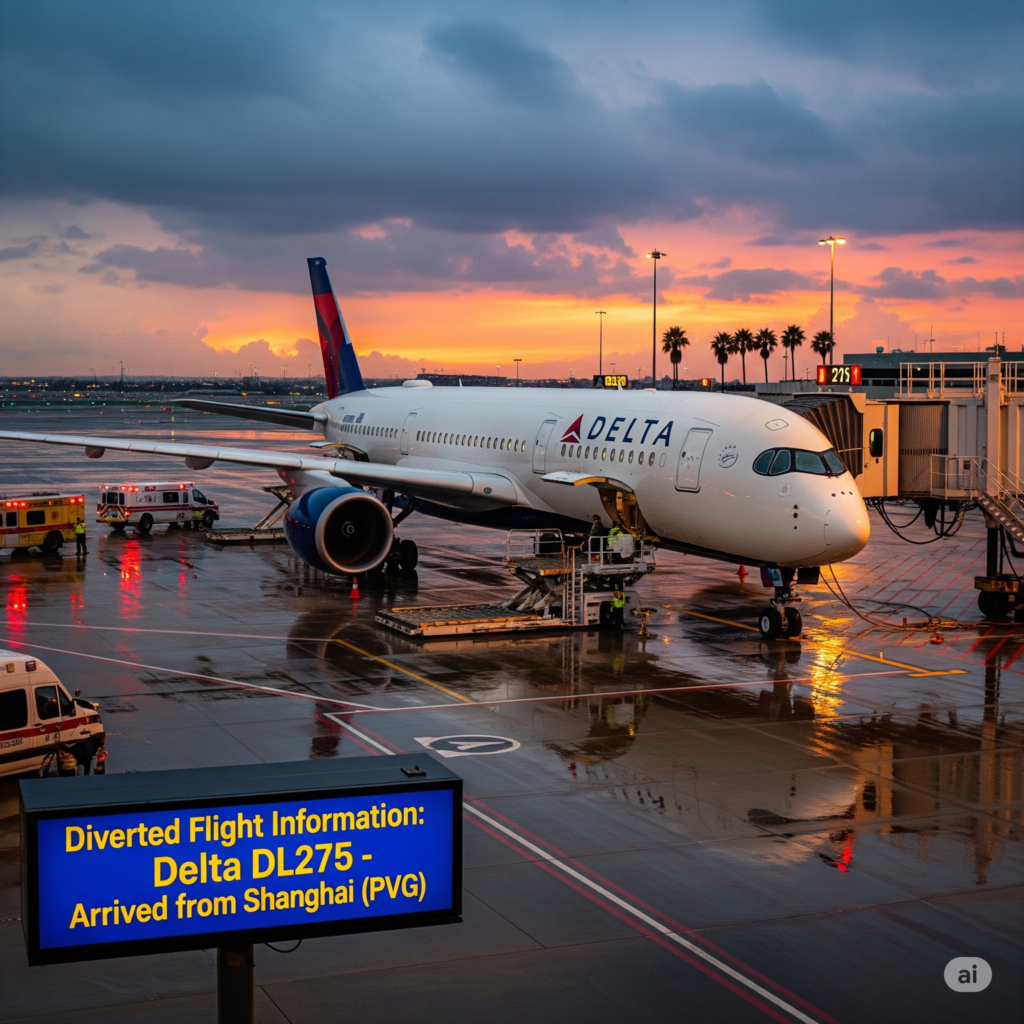
Once passengers had phone signal again, they wasted no time telling the world what happened. Photos of the jet parked at a remote LAX gate popped up online. Some shared screenshots of flight tracker apps showing the moment the aircraft turned. Others posted short updates or jokes about their unexpected layover.
One tweet read:
“Was supposed to be in Atlanta by now. Plane made a U-turn mid-Pacific. Now chilling in LA. #DL275”
Another post showed the moment the plane rerouted west, captioned simply,
“When your 13-hour flight decides it’s had enough halfway through.”
But not all posts were lighthearted. Some passengers expressed frustration over missed connections and the lack of information onboard. A few voiced concern that no one explained what really happened.
Still, most praised the crew’s calm approach and how Delta handled the unexpected stop. It didn’t feel like panic. It felt like precaution. That distinction matters.
What Happens to a Diverted Aircraft?
Once the plane was safely on the ground, the airline’s behind-the-scenes response kicked in. Mechanics inspected the systems. The captain submitted reports. Diagnostic tools were plugged into the aircraft to check every alert and signal.
The aircraft wasn’t rushed back into service. Delta pulled it from rotation, allowing technicians time to figure out what went wrong — or what the systems thought had gone wrong.
Meanwhile, passengers were rebooked onto new flights, offered overnight accommodations, and directed to customer service desks for support. It wasn’t the smoothest ending, but Delta’s response was quick.
Delta Flight DL275 diverted LAX, and while it didn’t reach Atlanta as planned, it landed safely — with all passengers unharmed and a crew that followed protocol by the book.
Why Precaution Wins in Aviation
It’s easy to forget just how much goes on behind the scenes of a commercial flight. The technology. The training. The checklists. And when something even slightly off pops up, pilots are taught to respond early — not wait.
In this case, the reroute was a sign of the system working.
Planes have backup systems for backup systems. But even with all that redundancy, airlines still lean toward caution. If a plane raises a red flag, especially one that can’t be cleared in-flight, landing is often the safest bet.
And LAX is well-equipped for that. It’s one of the top airports for handling international diversions, with full maintenance support, medical services, and enough gates to absorb unexpected traffic.
That’s why Delta Flight DL275 diverted LAX instead of continuing. Not because it had to. Because it was the smarter move.
Takeaways for Travelers
Flight diversions can feel dramatic, especially when you’re sitting in a window seat watching your route change. But most of the time, they’re handled exactly as they should be — with calm, care, and caution.
Here’s what this event reminds us:
- If your flight diverts, it’s not always an emergency
- The crew likely knows more than they can share
- Safety always outranks schedules
- Airports like LAX are set up for this kind of thing
- Staying calm helps you and everyone around you
So next time you hear of a flight going off-course, think of this one. Delta Flight DL275 diverted LAX not because something failed — but because the systems worked, and someone made a smart decision in real time.
Final Thoughts
In the end, the story isn’t about what went wrong. It’s about what went right.
A flight encountered a warning. The pilots reacted fast. The aircraft landed safely. Everyone got home, eventually. And while the internet buzzed with theories and tweets, the people who mattered — the crew and passengers — kept calm and got through it.
We may never know the exact fault that triggered the reroute. But we know this: Delta Flight DL275 diverted LAX with care, not chaos. And in aviation, that’s how you want every unexpected story to end.L